Fandango: Uncovering Critical Usability Issues in the Ticket Purchase Flow
Overview
Conducted as part of a 2-person research team, this study investigated why Fandango's ticket purchasing experience was underperforming. Through comprehensive usability testing with 7 participants, we uncovered critical pain points that were causing extended task completion times and low user satisfaction ratings.
Our research revealed systemic issues around pricing transparency, information architecture, and expectation management that were directly impacting the purchasing flow.
Role
UX Researcher
2-person research team
8 weeks
Methods
- Pre-study Surveys
- Cognitive Walkthroughs
- Moderated Usability Testing
- Task Analysis
- Persona Development
Tools
- Figma
- Google Forms
- Zoom
- Notion
The Problem
Fandango's ticket purchasing experience was receiving some of the lowest satisfaction ratings among all user tasks on the platform. Initial data showed that users were taking an average of 4 minutes and 13 seconds to complete a ticket purchase — significantly longer than industry benchmarks.
Our research team needed to understand:
- Why was task completion taking so long?
- What specific pain points were users encountering?
- Where in the flow were users getting stuck or frustrated?
Research Process
Phase 1: Discovery
We began with pre-study surveys to understand baseline movie-going habits, preferred theaters, and past experiences with online ticket purchasing platforms. This helped us identify potential participants and establish context before formal testing.
Early signals from surveys:
- Users frequently compared prices across multiple theaters before purchasing
- Hidden fees and unclear pricing were common frustrations
- Seat availability anxiety was high for popular films
Phase 2: Cognitive Walkthroughs
Before conducting moderated testing, we performed cognitive walkthroughs of the existing Fandango flow. This helped us identify potential friction points and develop targeted tasks for usability testing sessions.
Phase 3: Moderated Usability Testing
Our research team conducted moderated usability testing with 7 participants via Zoom. We split participants between team members to ensure consistency while allowing us to gather insights efficiently. Each session included task-based scenarios focused on the ticket purchasing flow.
Key tasks tested:
- Find and purchase tickets for a specific movie at a nearby theater
- Compare pricing across different theaters and showtimes
- Select specific seats for a popular film
- Complete the entire purchase flow from search to checkout
Meet Matt: Our Primary Persona
Through our research, we developed Matt, a 28-year-old movie enthusiast who represents our core user group. Matt sees multiple movies per month and values convenience and transparency when purchasing tickets.
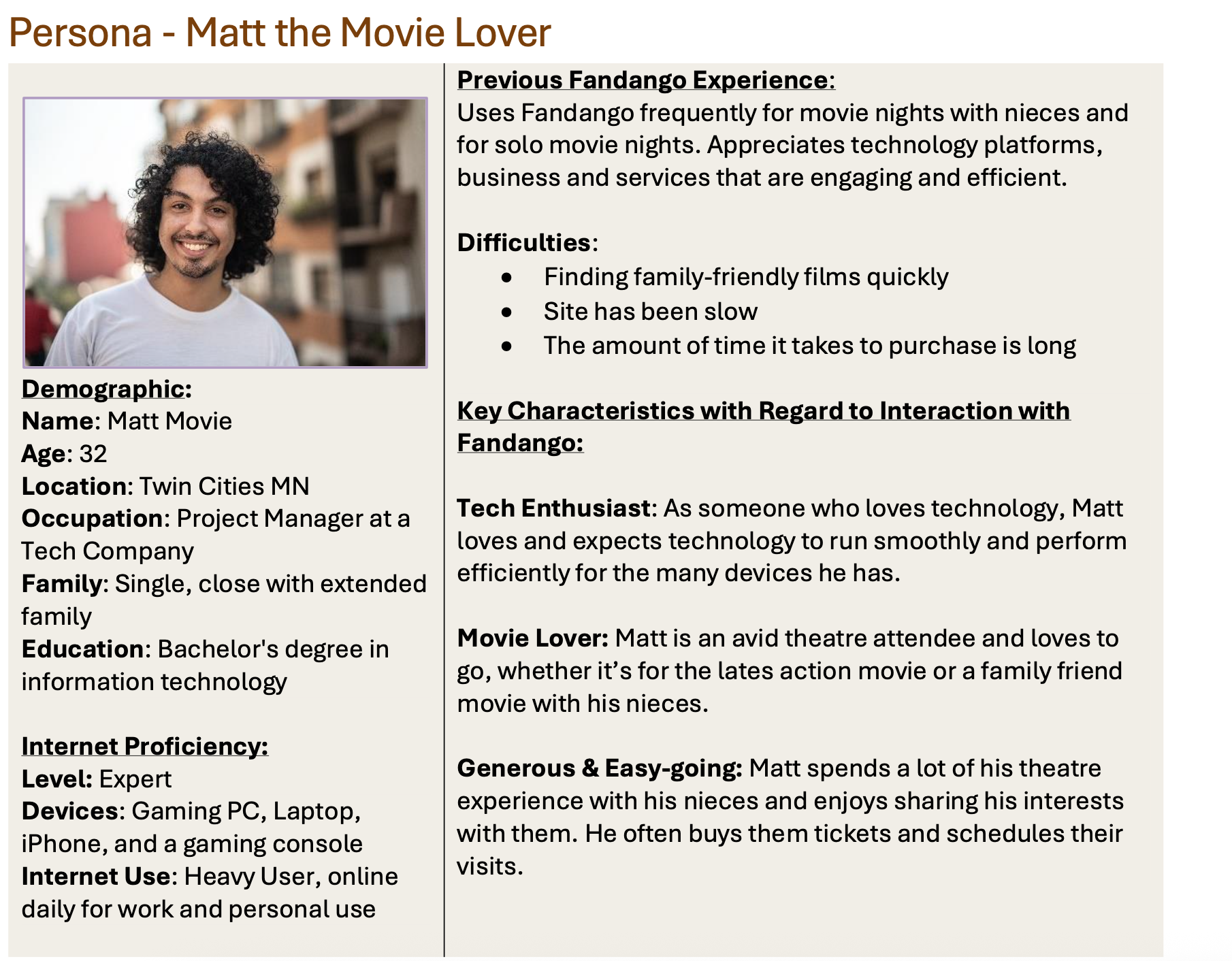
Matt's frustrations: He wants to quickly compare theaters and showtimes without discovering unexpected costs at checkout. He's frustrated by unclear pricing, hidden fees, and wasting time on options that become unavailable mid-purchase.
Key Findings
Our research uncovered three critical pain points that were directly impacting user satisfaction and task completion times.
Finding 01: Pricing Transparency Issues
Users could not see pricing information before selecting a theater or showtime. This lack of upfront transparency forced users to commit to a selection before understanding costs, leading to repeated backtracking as they compared options.
Impact: Users expressed frustration and uncertainty, with several participants abandoning their first selection to "shop around" after discovering unexpected prices.
Finding 02: Extended Task Completion Time
The average completion time of 4 minutes and 13 seconds indicated poor information architecture and unnecessary complexity in the flow. Users were getting lost, expressing confusion about their progress, and backtracking frequently.
Impact: Several participants commented that the process felt "longer than it should be" and that they "didn't know how many more steps" were remaining.
Finding 03: Seat Selection Frustration
For popular films, users experienced high anxiety when their desired seats became unavailable mid-selection. This forced them to restart their entire search, creating significant risk of purchase abandonment at a critical conversion point.
Impact: Participants expressed feelings of "wasting time" and losing confidence in the platform's reliability when seats vanished during the selection process.
Recommendations
Based on our findings, we provided the following recommendations in our research report:
Priority 1: Improve Pricing Transparency
Display pricing information earlier in the flow — before users commit to a theater or showtime selection. Consider adding "Check Prices" CTAs that allow users to preview costs without full commitment.
Priority 2: Add Progress Indicators
Implement clear progress indicators throughout the purchase flow so users understand where they are in the process and how many steps remain.
Priority 3: Set Expectations Around Seat Availability
Provide upfront messaging about seat availability and hold times, especially for popular films. Consider implementing a temporary hold system or clearer communication about when seats become locked.
Impact & Reflection
Deliverable: Our team delivered a comprehensive research report documenting all findings, participant feedback, personas, and prioritized recommendations. This report provided the foundation for future design improvements to the Fandango ticket purchasing experience.
What I learned: This project reinforced the importance of rigorous research methodology and the value of testing with real users. Analytics data told us that task completion was slow, but only through moderated testing could we understand the "why" behind the numbers.
Working as part of a research team taught me the importance of consistency in testing protocols and the value of collaborative analysis. By splitting participants but maintaining aligned methods, we were able to gather insights efficiently while ensuring reliability across sessions.
Want to see how these insights translated into design?
In the following semester, I used these research findings to redesign Fandango's ticket purchasing experience through UX writing.
View UX Writing Case Study →